Laser treatment is not selected by the word “piles” or by bleeding alone. Your haemorrhoid grade, the location of the tissue, the amount of prolapse, previous treatment and warning symptoms determine whether laser is suitable, whether another procedure is better, or whether surgery should wait for further investigation.
Key takeaways
- Goligher grade alone does not approve laser treatment.
- Internal prolapse and external disease change the suitable piles surgery option.
- A digital rectal examination and anoscopy help confirm treatment suitability.
- Severe prolapse, thrombosis or recurrent bleeding may favour conventional surgery.
Which haemorrhoid grades are candidates for laser treatment?
The Goligher grade gives a starting point, not an automatic approval for laser treatment. Laser piles surgery eligibility depends on the internal examination, symptoms, prolapse, previous treatment and whether external disease is present.
| Grade | What happens | Usual treatment direction |
|---|---|---|
| I | Stays inside; does not prolapse | Fibre, fluids, constipation treatment, less straining and shorter toilet sitting; surgery is rarely first choice |
| II | Prolapses during straining, then returns by itself | Rubber-band ligation, injection sclerotherapy or another office treatment often comes first; selected persistent cases may suit laser hemorrhoidoplasty |
| III | Prolapses during straining and needs manual replacement | Laser can suit selected internal cases; substantial external disease or advanced prolapse may favour another operation |
| IV | Remains permanently prolapsed and cannot be reduced | Laser reduction alone is less often suitable; conventional excisional surgery may provide a more definitive result |
Selected symptomatic grade II haemorrhoids can be considered for laser hemorrhoidoplasty only after fibre, fluids, constipation control or office treatment has failed. Grade III disease can also qualify when the haemorrhoids are mainly internal and the prolapse is suitable for reduction.
Grade IV, recurrent prolapse and a large mixed internal–external component often point toward excisional or another more definitive operation. Recovery can be more painful and slower, but removing advanced external tissue may prevent residual disease.
Persistent symptoms after appropriate treatment matter as much as the grade. So do recurrent prolapse and mixed disease. Bleeding alone does not establish when piles need surgery; eligibility is a clinical decision based on examination, not a checklist.
Does laser treat internal, external, prolapsing or thrombosed piles?
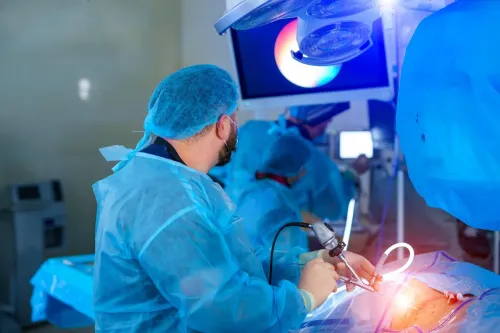
Laser treatment for haemorrhoids mainly addresses symptomatic internal haemorrhoids, especially selected grade II–III disease. In laser hemorrhoidoplasty, laser energy shrinks and coagulates the haemorrhoidal tissue; it does not remove the entire haemorrhoidal cushion.
| Condition | What laser may address | When a different plan is needed |
|---|---|---|
| Internal haemorrhoids | Selected symptomatic grade II–III disease | Persistent symptoms, advanced disease or substantial external tissue |
| Internal prolapse | Prolapse that remains suitable for tissue reduction | Severe, fixed or recurrent prolapse may need excisional surgery or another lifting procedure |
| External haemorrhoids | Only if the proposed operation specifically treats them | An internal laser procedure does not automatically treat external haemorrhoids or large skin-side components |
| Thrombosed external haemorrhoid | Not reliably treated by internal laser hemorrhoidoplasty | A painful, firm anal-margin lump, especially after recent severe onset, may require early excision |
| Mixed haemorrhoids | Internal symptoms may respond to laser | A substantial external component requires a separately planned treatment |
Confirm the operation’s name before consent. Laser-assisted excision is different from laser hemorrhoidoplasty because it removes tissue, so pain, recovery and recurrence expectations differ. Mixed disease, strangulation or a suspected abscess also require direct assessment rather than routine laser booking.
Ask: “Which tissue will you treat, and will the external component also be removed?” The answer helps establish laser piles surgery eligibility more reliably than choosing a procedure because bleeding is present.
What examination proves that laser surgery is appropriate?
No single symptom proves that laser surgery is appropriate. Laser piles surgery eligibility comes from a documented examination that confirms haemorrhoids and excludes other causes of bleeding.
1. Take a focused history. Record the bleeding pattern, prolapse, pain, constipation, straining, toilet habits, previous medicines, rubber-band ligation or surgery, and family history of bowel disease or cancer.
2. Inspect the anal area. Look for external lumps, fissures, skin changes, thrombosis, ulceration and a prolapsed mass. This distinguishes external or mixed disease from internal haemorrhoids that are not visible at rest.
3. Perform a digital rectal examination. A gloved finger checks the anal canal and rectum for tenderness, palpable masses and findings that could explain bleeding without piles.
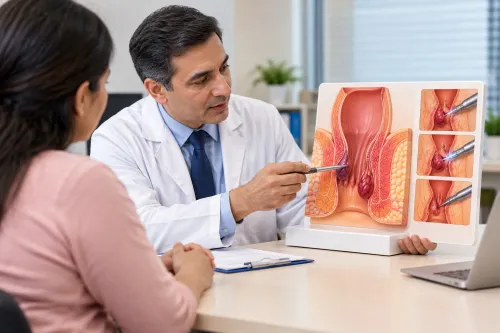
4. Use anoscopy to view the anal canal directly. It identifies internal haemorrhoids, documents their position and shows whether they prolapse during examination or straining.
Rectal bleeding must not automatically be blamed on piles. Persistent bleeding, altered bowel habit, unexplained weight loss, iron-deficiency anaemia, black stools, a palpable mass or a significant family history can require colonoscopy or another bowel evaluation.
Before booking a procedure, the recommendation should record the Goligher grade, internal, external or mixed location, prolapse behaviour, constipation status and red flags. That record—not bleeding alone—establishes whether laser is reasonable, or whether another treatment and bowel investigation come first.
When is an operation better than medicines, banding or laser?
An operation becomes more reasonable when grade III or IV prolapse persists, symptoms return after suitable office treatment, or mixed disease has a substantial external component. Bleeding alone is not the threshold; examination must show why less-invasive care is unlikely to solve the problem.
Fibre, adequate fluids, stool-softening treatment, avoiding straining and limiting toilet time remain appropriate for many grade I and grade II cases. Selected internal haemorrhoids without a large external component may suit rubber-band ligation, injection sclerotherapy or infrared treatment.
| Option | What it does | When it fits |
|---|---|---|
| Laser hemorrhoidoplasty | Reduces and coagulates haemorrhoidal tissue | Selected internal grade II–III disease |
| Laser-assisted excision | Removes tissue with laser support | Prolapse or tissue requiring excision |
| Conventional haemorrhoidectomy | Excises the haemorrhoidal masses | Advanced prolapse, recurrent disease or substantial external tissue |
| Stapled haemorrhoidopexy | Lifts and staples prolapsing mucosa | Internal prolapse without solving external disease |
| Doppler-guided HAL-RAR | Identifies and ties feeding arteries, then lifts prolapsing tissue | Selected internal prolapse |
Less tissue removal can mean less early pain and quicker activity, but residual or recurrent prolapse can be more likely than after definitive excision. When comparing piles surgery options in Dombivli East, ask which tissue will be treated and what happens if symptoms return.
Severe fixed prolapse, strangulation, thrombosis, suspected abscess, inflammatory bowel disease or suspected colorectal cancer makes laser treatment for haemorrhoids the wrong starting choice. A painful anal-margin lump may need assessment for early excision rather than an internal laser procedure.
How should you compare laser options before choosing a local surgeon?
A surgeon should document the diagnosis before recommending any of the piles surgery options in Dombivli East. Ask for the Goligher grade, whether the haemorrhoids are internal, external or mixed, and whether prolapse returns spontaneously, needs manual reduction or remains permanently outside.
Take these questions to the consultation:
- Is the procedure laser hemorrhoidoplasty or laser-assisted excision?
- Which tissue will be treated or removed?
- Will the external component also be addressed?
- What anaesthesia and day-care arrangements are required?
- How will constipation and straining be controlled?
- How many days should you expect to stay away from work?
- What is the risk of recurrence or residual prolapse?
- What is the plan if bleeding, prolapse or pain returns?
| Option | What it does | Key limitation |
|---|---|---|
| Laser hemorrhoidoplasty | Shrinks and coagulates selected internal tissue | May leave external disease or residual prolapse |
| Banding or sclerotherapy | Treats suitable internal haemorrhoids in the clinic | Less suitable for large mixed disease |
| HAL-RAR | Ties feeding arteries and lifts prolapsing tissue | Does not remove substantial external tissue |
| Stapled haemorrhoidopexy | Lifts and staples prolapsing mucosa | Does not address external haemorrhoids |
| Conventional haemorrhoidectomy | Excises haemorrhoidal masses | More painful and slower recovery |
At Jeevanshree Hospital, a documented examination and options discussion is more useful than choosing by location or a promise of comfort.
The question “which piles cases need laser surgery in Dombivli East” has a practical answer: laser is most plausible for selected symptomatic internal grade II–III disease after diagnosis; advanced external, strangulated, thrombosed, infected or unexplained bleeding needs a different pathway.
Related service
Laser Piles Surgery also known as Laser Hemorrhoidoplasty or Laser Hemorrhoidectomy, is a minimally invasive surgical procedure used to treat hemorrhoids, which are... View service → |
Frequently asked questions
Which haemorrhoid grades are candidates for laser treatment?
Laser treatment is considered mainly after examination of symptomatic internal haemorrhoids, often grades I to III. Grade IV prolapse, substantial external disease or mixed haemorrhoids may require another operation.
Does laser treat internal, external, prolapsing or thrombosed piles?
Laser procedures are designed primarily for selected internal haemorrhoids. External piles, skin tags, irreducible prolapse and thrombosed haemorrhoids need separate assessment because laser may not address the underlying problem.
What examination proves that laser surgery is appropriate?
A surgeon should review your symptoms and perform a digital rectal examination and anoscopy. Prolapse, bleeding source, external components and other causes of bleeding must be assessed before choosing laser treatment.
When is an operation better than medicines, banding or laser?
Surgery becomes more suitable when piles remain symptomatic after conservative treatment, prolapse is advanced or recurrent, external disease is significant, or bleeding and thrombosis require direct treatment. Rubber-band ligation can suit selected internal piles, while medicines do not remove established prolapse.
How should you compare laser options before choosing a local surgeon?
Ask which haemorrhoid grade and tissue the procedure treats, who performs it, what anaesthesia and follow-up involve, how recurrence is handled, and when conventional surgery or banding would be safer. Confirm the surgeon examines you before recommending laser treatment.
Keywords